Every Expert Advisor on this site carries a minimum capital label, and two of them read something like $5k+/$50+. That slash is what this post is about. The first number is what the EA needs on a normal account. The second is what it needs on a cent account, and it is not a discount. It is the same test at one hundredth of the size.
Cent accounts get sold as a beginner’s on-ramp. That is not what they were built for. They were created so people could develop and test trading systems with real money, which is exactly what I use them for and what the rest of this post is about.
What a cent account actually is
A live account where the balance is denominated in cents rather than dollars. Deposit $50 and MetaTrader shows 5,000, usually labelled USC. That relabelling is cosmetic. The part that matters is underneath it.
On a cent account a lot is worth one hundredth of a standard lot. One standard lot is 100,000 units of the base currency; one cent lot is 1,000. So the smallest trade MT5 will accept, 0.01 lots, moves your account by roughly one hundredth of what the same 0.01 lots would move a standard account.
Everything else is real. Real spread, real slippage, real swap charged overnight, real gaps on Sunday open, real requotes when liquidity thins out.
The maths nobody shows you
Here is what actually goes wrong when you try to test an EA on a small standard account, and it is not “you might lose money”.
MT5’s minimum trade size is 0.01 lots. On a standard account, 0.01 lots on EURUSD is worth about $0.10 per pip. That sounds harmless until you put it on a $100 account. A 50-pip stop is then $5, which is 5% of the account on a single trade.
No sensibly configured EA will accept that. Mine will either refuse to trade, because the position the risk setting asks for is smaller than the broker’s minimum, or they will be forced up to a size their own risk maths never intended. Either way you are no longer testing the EA. You are testing a distorted version of it, and the drawdown you observe tells you nothing about the drawdown you would get at proper size.
On a cent account that same 0.01 lots is worth about $0.001 per pip. A $50 deposit now behaves like a $5,000 account. The EA sizes positions exactly as it would on the real thing, the percentages come out right, and the equity curve you get is a genuine, miniature preview.
That is the whole argument. A cent account is not useful because you risk less. It is useful because it is the cheapest way to run an EA at its correct risk settings.
Why this beats a demo account
Demo is good for the things demo is good for. Checking the EA attaches and loads, that your inputs are right, that the dashboard appears, that AutoTrading is on, that the licence check passed. If you are working through how to install an EA, do it on demo.
What demo cannot show you is how your broker behaves when it has to fill a real order. Demo servers fill at the quoted price, near enough instantly, near enough always. A live server has queues, requotes, slippage that widens around news, and an execution model the broker chose. For anything that places pending orders or manages a basket of positions, that gap is not cosmetic.
Demo tests your setup. Cent tests your broker.
The traps that only bite EA users
This part is missing from every guide I found on this topic, which is odd, because it is where people actually get hurt.
Check the minimum lot before you assume anything. On Ultima’s cent account it is 0.01, the same as a standard account, so the maths above holds. That is not universal. Some brokers set the cent minimum at 0.1, and an EA with a hardcoded 0.01 will simply never open a trade. If nothing happens for a week, this is the first thing to check.
Money-denominated settings are the real landmine. Any input expressed in account currency reads as cents on a cent account. A basket target of “$50 profit” becomes 50 cents. A drawdown limit of “$200” trips at $2. Percentage settings are immune. Money settings are not.
All of my EAs handle cent accounts correctly by default, so this is one you can ignore with mine. Check it on anything else you run.
Third-party tools do not always understand USC. Journals, trade copiers and statistics sites occasionally read a cent-denominated statement as dollars and report your balance at a hundred times what it is. Worth knowing before you panic at a number.
Where a cent account lies to you
Read this before you draw conclusions from your results, because the honest answer is that the transfer to a standard account is not one-to-one.
Costs do not always scale the way the position does. Spread and commission stay proportional to the position you open, but plenty of brokers price their cent accounts like a retail account instead of a raw-spread one. Test on one of those and every trade costs you more than it will on the account you eventually scale to, which quietly makes the strategy look worse than it is.
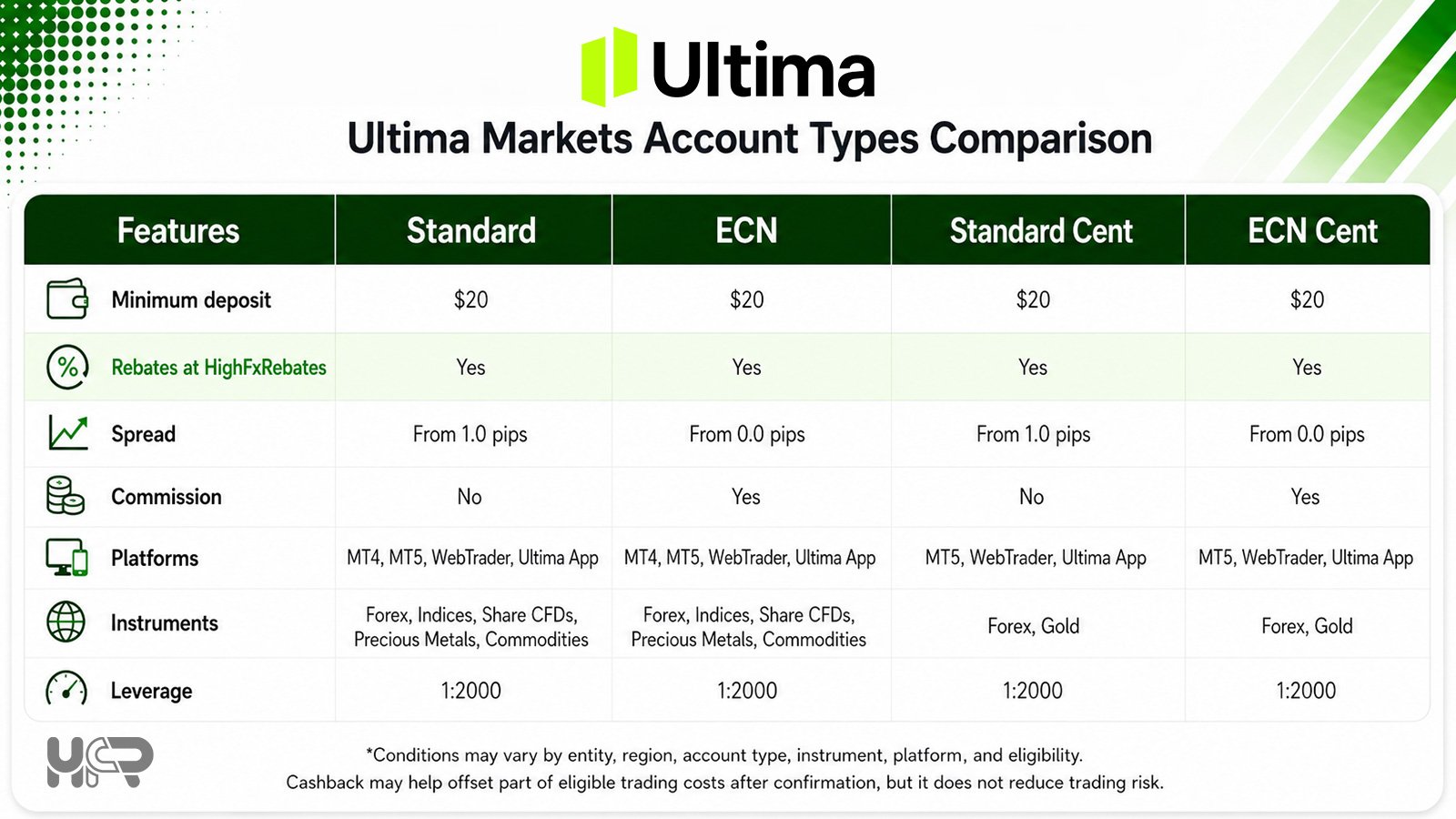
That one is avoidable. Ultima runs an ECN Cent account — raw spreads and commission, at cent size. That combination is the one you want, because the cost structure you are testing under is the same one you will be trading under later.
The execution model is not the one you will scale to. Retail cent accounts are dealt in-house, B-book, essentially across the whole industry. Ultima included. Raw-spread and ECN accounts route out to liquidity providers instead. So the fills you measure on a cent account are not produced the same way as the fills you will get afterwards. For most strategies that gap is small enough to ignore. For anything that lives on slippage and fill quality, treat the cent result as indicative rather than final.
There is a floor, and it is the same floor. At $50 on a cent account you are running the equivalent of $5,000. Go much below that and you are back in the same trap as the small standard account, a hundred times down.
Cent accounts come with strings. Maximum balance and maximum position size are usually capped, and leverage is commonly tiered — generous while the balance is small, stepping down as it grows. Neither matters much during the test. Both matter the moment you forget about them, because an account on tiered leverage behaves differently at $500 than it did at $50. That reads as the strategy changing when it is the account changing.
How long to test, and what makes you stop
Everybody asks how many weeks. That is the wrong unit, and it is the most common mistake I see people make with forward testing.
It is never about time. It is about trades. A month tells you nothing on its own — a fast EA can hand you more information in a week than a swing strategy produces in a quarter, and running the calendar down does not make a sample any bigger.
So count trades. For a fast-trading EA, 50 trades gives you something worth reading. For a slower swing strategy, 10 or more is already plenty to gauge whether it is doing what it is supposed to do.
Ten sounds too small if you are used to thinking about statistical significance, and for proving an edge it would be. That is not what this test is for. The edge question should have been answered before deciding to deploy the strategy on real money. What you are checking here is narrower and much easier to answer: does this thing behave on a live server, with real fills and real costs, the way it behaved in testing?
Decide before the first trade what result would make you stop, and write it down. Then honour it.
And do not intervene. A forward test you have been adjusting is a demonstration, not a test.
When to leave the cent account
Move up when the test has told you something, not when you get bored of waiting.
You will not have a verified live track record to compare against. If you did, you would not be running this test. What you do have is the backtest — yours, or whatever the EA shipped with — and that is the benchmark.
Run it over the same dates you just traded, with the same settings, and compare the shape rather than the number. Is it winning and losing in the same places? At roughly the same rate? Are the drawdowns similar in character, even if not in size? Agreement means the strategy is behaving and the only variable left is size. Sharp divergence means something in your live setup differs from the test, usually broker conditions, occasionally a settings mismatch, and scaling would only make that more expensive to find out.
When you do move, move to the account type you actually intend to run, and expect the first stretch to differ a little.
Which broker, and why
I went through every cent account I could find in the industry before settling on one, and I could not find better conditions anywhere than Ultima Markets. That is why it sits in the broker comparison as the low-cost testing option. The minimum deposit is $50, and the ECN Cent account gives you raw spreads at cent size, which most of the field does not.
It is also not a dead end. When the test is finished you do not have to change broker — you move from the ECN Cent account to their normal ECN account and keep the same conditions at full size. That continuity matters more than it sounds, because it removes the one variable you would otherwise introduce at exactly the moment you start trading real money.
Open an Ultima Markets cent account
Once it is open, request whichever EA you want to test from the licence form and it costs you nothing.
The whole exercise runs to about the price of a takeaway and the patience to leave it alone until the trades are in. Set against funding a $5,000 account to find out whether you can sit through the drawdown, it is the best value in retail trading.
Trading carries risk, and a short forward test is evidence rather than proof. Nothing here is financial advice. It is how I test my own software before I trust it with size.